How To Measure Bike Frame Size
Choosing the right size bike frame is the single most important decision you'll make when buying a new bike. A correctly sized frame provides comfort, efficiency, and confident handling, while the wrong size can lead to discomfort, pain, and poor performance. This guide provides clear, step-by-step instructions on how to measure your body and an existing bike frame to find your perfect fit, whether you're buying your first road bike or a new mountain bike online.
Fast Answer
- Measure your inseam: Stand against a wall and measure from the floor to your crotch. This is the most critical body measurement.
- Measure the bike's seat tube: This is the traditional method, measuring from the centre of the pedal cranks to the top of the seat tube.
- Check manufacturer charts: Always compare your measurements to the specific size guide for the bike model you're considering.
Before You Start
Gathering a few simple items will ensure your measurements are accurate. It's often easier to have a friend or family member help you, especially when measuring your own body.
- A reliable tape measure (a metal one is best for accuracy).
- A large, hardcover book with a straight spine, or a spirit level.
- A clear, flat wall to stand against.
- A pencil for marking the wall lightly.
- A notepad and pen, or a phone to record your measurements.
- The bike you want to measure (if checking an existing frame).
Step-by-Step Instructions
We'll cover two primary methods. The first, measuring your body, is essential when buying a new bike. The second, measuring a bike frame directly, is useful for checking a second-hand bike or understanding your current bike's size.
Measure Your Body's Key Dimensions
Your body proportions, especially your leg length, are the most important factors in determining the right frame size. This is often called the "rider-first" method.
First, prepare to measure your inseam, also known as your inside leg measurement. This is not the same as your trouser inseam. Remove your shoes and stand with your back flat against a wall, with your feet about 15-20 cm (6-8 inches) apart, mimicking the position you'd be in when straddling a bike.
Take a large hardcover book and place it between your legs. Slide the book upwards until the spine is pressed firmly into your crotch, applying similar pressure to what you would feel from a bike saddle. It's crucial that the book is level with the floor. Use a spirit level on top of the book if you have one, or ask a helper to check.
Once the book is firm and level, hold it in place and have your helper make a small, light pencil mark on the wall at the top edge of the book's spine. If you are alone, carefully hold the book in place with one hand and make the mark yourself. Now, step away from the wall and use your tape measure to measure the distance from the floor up to the pencil mark. This measurement is your cycling inseam.
Calculate Your Standover Height Clearance
Standover height is the distance from the ground to the top of the bike's top tube (the bar that runs between the handlebars and the seat). Your inseam measurement determines the maximum standover height you can comfortably manage.
You need to be able to stand over your bike with your feet flat on the ground and have some clearance between your body and the top tube. This is a critical safety feature, allowing you to dismount quickly and avoid injury.
The amount of clearance needed varies by bike type due to different riding terrains and styles:
- For road bikes and hybrid bikes: Aim for at least 2-5 cm (about 1-2 inches) of clearance between your inseam and the top tube.
- For mountain bikes: You need more clearance for manoeuvring on uneven trails. Aim for at least 5-10 cm (about 2-4 inches) of clearance.
When looking at a bike's geometry chart online, find the "Standover Height" number and subtract it from your inseam measurement to see if it provides adequate clearance.
Use Your Inseam to Estimate Frame Size
For decades, simple formulas have been used to provide a starting point for frame size based on inseam. While modern bike geometries are more complex, these calculations are still excellent for getting you into the right ballpark before you consult a specific brand's size chart.
Make sure your inseam measurement is in centimetres for these formulas:
- Road Bike Frame Size (cm) = Your Inseam (cm) x 0.67
- Mountain Bike Frame Size (cm) = Your Inseam (cm) x 0.59
- Hybrid Bike Frame Size (cm) = Your Inseam (cm) x 0.63
For example, if your inseam is 85 cm, a good starting point for a road bike would be 85 x 0.67 = 56.95 cm, suggesting a 56 cm or 57 cm frame. For a mountain bike, it would be 85 x 0.59 = 50.15 cm. Since MTBs are often sized in inches, you would convert this (50.15 cm / 2.54 = 19.7 inches), suggesting a 19" or "Large" frame.
Measure a Bike Frame's Seat Tube
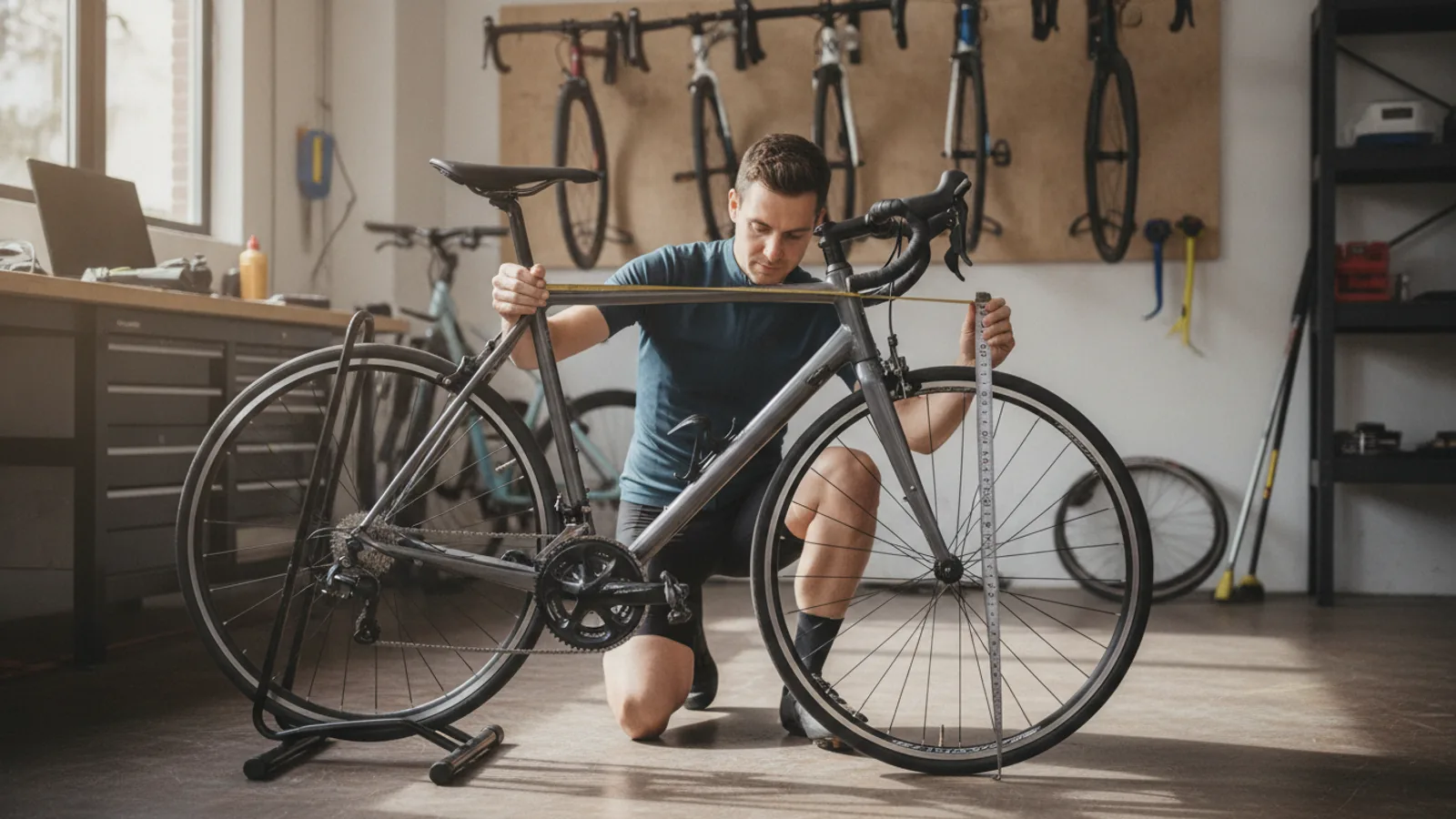
If you have a bike in front of you, you can measure it directly. The most traditional measurement for frame size is the seat tube length. This is what manufacturers historically used to label sizes like "54cm", "56cm", etc.
To measure the seat tube, you need to identify the bottom bracket. This is the cylindrical shell at the bottom of the frame where the pedal cranks rotate. You will measure from the exact centre of this circle.
Extend your tape measure from the centre of the bottom bracket up along the seat tube. The key question is where to stop measuring, as there are two common methods:
- Centre-to-Top (C-T): Measure from the centre of the bottom bracket to the very top of the seat tube, where the seat post is inserted. This is a common method for many classic road and hybrid bikes.
- Centre-to-Centre (C-C): Measure from the centre of the bottom bracket to the centre of the point where the top tube intersects the seat tube. This method is often used for modern road bikes and is sometimes considered more consistent.
Unfortunately, manufacturers don't always state which method they use. If you are comparing a bike you've measured to an online chart, try to see if their geometry diagram clarifies the measuring points. If not, C-T is often a safe assumption for a general size number.
Measure a Bike Frame's Top Tube (Reach)
For modern bike fitting, the length of the top tube is often considered more important than the seat tube length. This measurement dictates your "reach" – how far you have to stretch to hold the handlebars. A bike with the wrong reach can cause back, shoulder, or neck pain.
Most modern bikes feature a sloping top tube for increased standover height. Because of this, measuring along the tube itself is misleading. Instead, you must measure the Effective Top Tube (ETT) length.
The ETT is the horizontal distance from the centre of the head tube (where the handlebars connect to the frame) to the centre of the seat post. Imagine a perfectly horizontal line extending back from the top of the head tube until it is directly above the seat post. This is the length you need to measure.
To do this, hold your tape measure level with the ground. Start at the centre of the top of the head tube and measure horizontally back to the centre of the seat post. This number is the single best metric for comparing the "feel" of how stretched out you'll be between two different bikes.
Quick Reference
| Situation | Use This Measurement | Why It Matters |
|---|---|---|
| Buying a new bike online | Your personal inseam measurement | This is the best starting point to use with any manufacturer's size chart. |
| Checking for basic safety and fit | Standover Height vs. Your Inseam | Ensures you can get on and off the bike safely without injury. |
| Understanding a bike's traditional size label (e.g., 54cm) | Seat Tube Length | The classic, though now less critical, indicator of a frame's size. |
| Comparing how "stretched out" you will feel on different bikes | Effective Top Tube Length (ETT) | This is the most important factor for upper body comfort on longer rides. |
Common Problems When You Measure Bike Frame Size
Even with careful measurements, you can run into tricky situations. Here’s how to handle the most common issues.
Problem: My measurements put me between two sizes.
This is a very common scenario. The choice often comes down to your riding style and body proportions. As a general rule:
- Choose the smaller size if: You have shorter arms or torso for your height, you prefer a more nimble and responsive handling feel, or you want a more aggressive, aerodynamic riding position (with a larger drop from the saddle to the handlebars).
- Choose the larger size if: You have longer arms or torso for your height, you prefer a more stable and planted ride feel, or you prioritise comfort and a more upright riding position.
A smaller frame can often be "sized up" with a longer seat post and stem, but it's much harder to make a frame that is too large feel smaller and more comfortable.
Problem: Different brands recommend different sizes for me.
This isn't a problem, it's a reality of the cycling industry. A "Medium" from one brand can have a completely different geometry from a "Medium" from another. Never assume sizing is consistent across brands.
The solution is to ignore the size label (S/M/L or 54/56/58) and instead focus on the specific geometry numbers on the chart. Compare the Effective Top Tube length, Standover Height, and (if you're more advanced) the Stack and Reach figures. This is the only way to make a true apples-to-apples comparison.
Problem: I'm measuring a bike with a very unusual frame shape.
For bikes with swooping tubes, step-through frames, or aggressive suspension linkages, stick to the fundamental principles. Standover height is always measured from the ground to the top tube at the point you would physically stand. Effective Top Tube is always a purely horizontal line. Don't measure along the curves of the tubes, as this will give you inaccurate and useless numbers.
Advanced Tips for Measuring Bike Frame Size
Once you've mastered the basics, these concepts will help you refine your choice even further and understand the nuances of bike fit.
Understand Stack and Reach
Stack and Reach are the measurements professional bike fitters use to compare frames. They provide a standardised way to assess a bike's fit that isn't influenced by seat tube angles or other variables.
- Reach: The horizontal distance from the centre of the bottom bracket to the centre of the top of the head tube. It's a precise measure of how long the bike will feel when you're standing on the pedals. It's similar to, but more precise than, ETT.
- Stack: The vertical distance from the centre of the bottom bracket to the centre of the top of the head tube. This determines how high the handlebars will be. A higher stack means a more upright, relaxed position; a lower stack means a more aggressive, aerodynamic position.
If you're looking for a comfortable endurance bike, look for a model with a higher stack and shorter reach. If you're a competitive racer, you'll likely prefer a bike with a lower stack and longer reach.
Consider Your Flexibility and Riding Goals
The perfect frame size isn't just about your body measurements; it's also about your body's capabilities. A highly flexible rider can comfortably tolerate a long reach and a low stack height. A rider with tighter hamstrings or less core strength will need a shorter reach and higher stack to avoid back pain. Be honest about your own flexibility and the type of riding you plan to do. An aggressive race-fit frame will be miserable on a leisurely charity ride if you're not conditioned for it.
Remember Component Adjustments
The frame is the heart of the bike, but it's not the final word on fit. Small adjustments to components can make a huge difference. Swapping to a longer or shorter stem can adjust your reach by several centimetres. Raising or lowering the handlebars with spacers can alter your posture. The fore-and-aft position of your saddle can also fine-tune your relationship to the pedals. A bike that is the correct size can be perfectly dialled-in with these adjustments; a bike that is the wrong size cannot.
How To Measure Bike Frame Size FAQ
Can I just use my height to find my bike size?
Using a simple height chart is a very rough starting point, but it's often inaccurate. People of the same height can have vastly different leg and torso lengths. Your inseam measurement is a far more reliable indicator of the correct frame size because it directly relates to standover height.
What is the difference between men's and women's bike frames?
Traditionally, women-specific frames were designed with shorter top tubes and taller head tubes to accommodate average female proportions. However, the modern trend is towards unisex frames, with fit being customised through women-specific "touch points" like saddles, narrower handlebars, and shorter stems. The process for measuring a frame is identical regardless of its gender label. Focus on the geometry numbers, not the marketing.
Do road bike and mountain bike sizes mean the same thing?
No, they are completely different. Sizing scales and geometry are designed for entirely different purposes. A "Large" mountain bike is not comparable to a "Large" (or 58cm) road bike. You must use the appropriate size chart and measurement conventions for the specific type of bike you are considering.
Should I measure in centimetres or inches?
It depends on the bike type. Road bikes are almost universally measured and sold in centimetres (cm). Mountain bikes are often measured in inches or, more commonly today, with S/M/L/XL labels. Hybrid bikes can be either. The most important thing is to be consistent and use the same units that the manufacturer uses in their size chart.
Final Checklist for Measuring Bike Frame Size
Before you commit to a purchase, run through this final checklist to ensure you've covered all the bases.
- You have accurately measured your cycling inseam in bare feet.
- You have confirmed the bike you're considering provides adequate standover clearance (2-5cm for road/hybrid, 5-10cm for MTB).
- You have identified the correct bike type (Road, MTB, Hybrid) and are using the right kind of size chart.
- You have matched your inseam measurement to the specific manufacturer's official size guide.
- If between sizes, you have compared the Effective Top Tube (ETT) length to decide if a longer or shorter reach is better for you.
- You have considered your personal flexibility and preferred riding style (aggressive vs. relaxed).
- You have double-checked all your measurements one last time.